

Coyote vs. Acme was finished in 2022, shelved by Warner Bros. as a tax write-off in 2023, and bought by Ketchup Entertainment for $50 million. This month it passed $100 million worldwide, and it arrives on digital on 29 September.
The rescue is the headline. The reason people keep recommending it is simpler: Wile E. Coyote looks like he is actually standing in the room. That is harder than it looks, and most of it is decided before anyone opens a compositing app.
We did not work on the film — DNEG worked on the character integration, and their breakdown is worth watching. This is what any shot like it has to get right, whether it is a feature or a thirty-second ad with a mascot in a kitchen.
Why hybrids usually look fake
When a drawn character sits on top of a photographed plate, the eye does not complain about the drawing. It complains about the relationship. Three failures account for most of it:
- The light disagrees. The plate has a key from camera left and a warm bounce off the floor; the character is lit flat, or from somewhere else.
- Nothing touches. No contact shadow under the feet, no dent in the cushion, no dust when he lands. The character floats a few millimetres above the world.
- Nobody is looking at him. The actor’s eyeline is ten centimetres off, and the audience feels it before they can name it.
Stylisation does not excuse any of these. A flat, graphic character still has to obey the room’s light direction and still has to touch the floor. The style decides how the light is drawn, not whether it is there.
What has to happen on set
Almost everything that makes integration cheap is captured on the day, in minutes. The full list is in What VFX needs from your shoot; for a character shot, four things matter most.
A stand-in at the right height
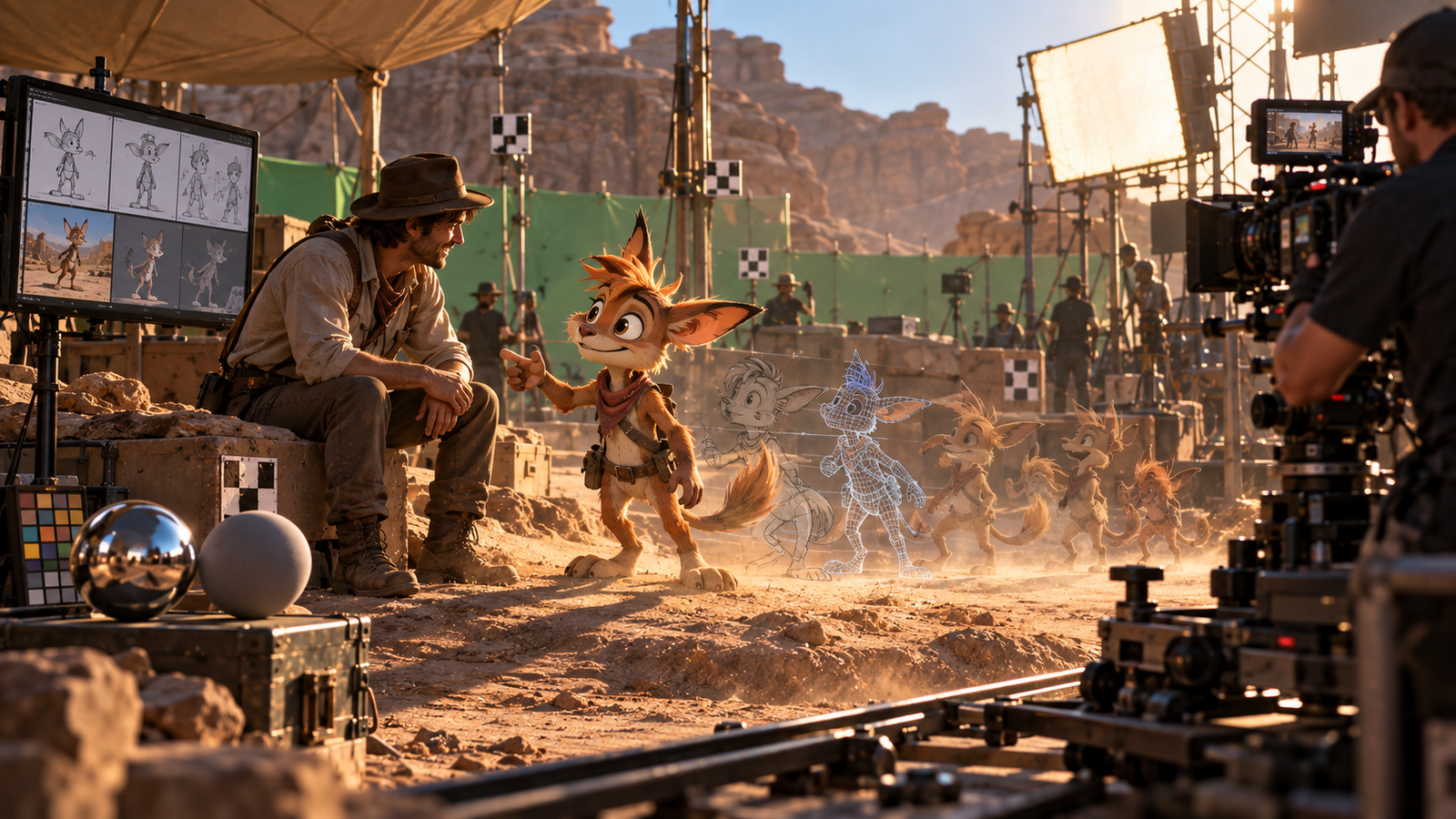
Something physical for the actor to look at and react to — a maquette on a stick, a tennis ball on a C-stand, a performer in grey. Eyeline is the one thing that cannot be fixed in post without re-animating the character around the mistake.
Light reference
A chrome ball and a grey ball, shot where the character will stand, in the scene’s light. Thirty seconds, and the lighting match starts from evidence instead of guesswork.
A clean plate
The same camera move with the stand-in removed. Every frame the stand-in covered otherwise has to be painted back by hand.
Interaction that really happens
If the character knocks over a chair, have someone pull the chair on a line. A real object falling in real light will always beat a CG one, and animating to a practical event is easier than inventing one. The animator’s job becomes explaining why the chair fell.
What happens in comp
Once the character is animated and rendered, the compositor’s job is to make two images look like they came through one camera. The details are unglamorous:
- Match the grain. The plate has film or sensor noise; a clean render on top of it reads as a sticker. Give the character the plate’s grain, not a generic one.
- Match the lens. Same depth of field, same distortion, same softness toward the edges. A character sharper than whatever is in focus looks pasted on.
- Light wrap and spill. Let a little of the background bleed around the character’s edge, and a little of the character’s colour bounce onto nearby surfaces.
- Shadows and contact. Cast shadows that follow the room’s geometry, plus a tight contact shadow wherever he touches something. This one element does more than any other.
None of these is impressive on its own. Together they are the difference between a cartoon in a room and a cartoon on a screen in front of a room.
The part a brand can use
Most studios will never make a feature like this, and most brands will never need one. But the same technique at a smaller scale is one of the most effective things in advertising: a mascot on a real kitchen counter, a product character on a shop shelf, a logo that walks across a desk.
The budget question is not whether the character is 2D or 3D. It is how many shots there are, how much the character touches, and whether the shoot captured what post needs. Shots planned for integration cost far less than the same shots rescued afterwards — which is part of why we quote in shots, not days.
If you are planning something like this, talk to us before the shoot, not after it. See how we handle integration, or get in touch.
Comments
Loading comments…